As Artificial Intelligence becomes more advanced, organizations are moving beyond using a single AI assistant. Instead, they are building teams of AI agents that collaborate to complete complex tasks.
Managing these intelligent systems requires something known as AI Agent Orchestration.
Although the term may sound technical, the idea is straightforward: it is the process of coordinating multiple AI agents so they can work together efficiently toward a common goal.
Understanding AI agent orchestration is becoming increasingly important for AI Engineers, AI Automation Engineers, software developers, and business leaders who want to build scalable AI-powered systems.
What Is AI Agent Orchestration?
AI agent orchestration is the coordination and management of multiple AI agents, tools, and workflows so they can complete tasks efficiently.
Instead of relying on one AI model to do everything, organizations create specialized AI agents with different responsibilities.
An orchestration system ensures each agent:
- Receives the right task
- Shares information when necessary
- Works in the correct sequence
- Delivers results to the next agent
- Contributes to the overall objective
Think of it like a project manager coordinating a team of specialists.
Why Is AI Agent Orchestration Important?
As AI systems become more capable, businesses want them to perform complete business processes rather than isolated tasks.
For example, instead of simply answering customer questions, an AI-powered customer support system might:
- Understand the customer's request
- Search company documentation
- Check order history
- Generate a response
- Escalate complex issues to a human agent
- Record the interaction in a CRM
These activities often involve multiple AI agents working together.
How AI Agent Orchestration Works
A typical orchestration workflow follows these steps:
1. Receive a Goal
The system receives an objective such as processing a customer request or generating a market research report.
2. Break the Task into Smaller Jobs
The orchestration engine identifies which AI agents should perform each task.
3. Coordinate the Agents
Each agent performs its assigned responsibility while sharing information with the rest of the system.
4. Combine the Results
The outputs from all agents are merged into a final result.
5. Monitor Performance
The orchestration platform tracks execution, identifies failures, and improves future workflows.
Types of AI Agent Orchestration
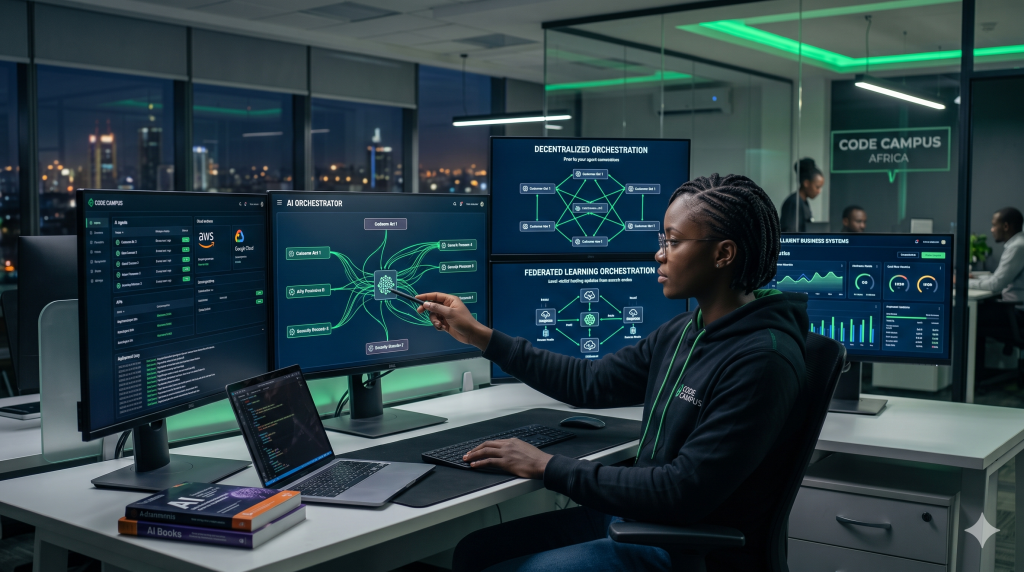
Centralized Orchestration
One central controller coordinates all AI agents.
Advantages:
- Easier to manage
- Simpler monitoring
- Consistent decision-making
Challenges:
- Single point of failure
- Can become a bottleneck as systems grow
Decentralized Orchestration
AI agents communicate directly with one another without relying on a central coordinator.
Advantages:
- Highly scalable
- More resilient
- Faster decision-making
Challenges:
- More difficult to monitor
- Increased system complexity
Federated Orchestration
Several groups of AI agents have their own local coordinators, and those coordinators communicate with each other.
Advantages:
- Suitable for large organizations
- Scalable
- Easier to manage than fully decentralized systems
This approach is becoming increasingly popular in enterprise AI environments.
Real-World Examples
AI agent orchestration can be used for:
- Customer support automation
- AI software development
- Business process automation
- Healthcare workflows
- Financial reporting
- Sales automation
- Research assistants
- HR recruitment
Skills Needed to Build AI Agent Systems
Professionals working with AI orchestration should understand:
- Artificial Intelligence
- APIs
- Python
- Workflow automation
- Cloud computing
- Databases
- Prompt engineering
- AI agents
Knowledge of system architecture is also valuable.
Why Businesses Are Investing in AI Agent Orchestration
Businesses want AI systems that can:
- Automate repetitive work
- Improve productivity
- Reduce costs
- Deliver consistent customer experiences
- Scale efficiently
AI orchestration makes these goals achievable by allowing multiple intelligent systems to work together seamlessly.
The Future of AI Agent Orchestration
Industry experts expect AI agent orchestration to become a foundational technology for modern businesses.
Instead of deploying individual AI tools, organizations will increasingly build networks of specialized AI agents that collaborate across departments.
Professionals who understand AI orchestration will be well-positioned for careers in AI, automation, and software engineering.
Final Thoughts
AI agent orchestration is transforming Artificial Intelligence from isolated tools into coordinated systems capable of solving complex business problems.
As AI adoption accelerates, understanding how intelligent agents collaborate will become an increasingly valuable skill for developers, engineers, and technology professionals.
Whether you're beginning your AI journey or planning a career in AI Automation Engineering, learning AI agent orchestration will prepare you for the next generation of intelligent software.
Frequently Asked Questions
What is AI agent orchestration?
AI agent orchestration is the process of coordinating multiple AI agents so they work together toward a common goal.
Why do businesses use AI agent orchestration?
It helps automate complex workflows, improve productivity, and coordinate multiple AI systems efficiently.
What is the difference between an AI agent and AI orchestration?
An AI agent performs specific tasks, while orchestration manages how multiple AI agents collaborate.
What are the three orchestration models?
The three common models are centralized, decentralized, and federated orchestration.
Is AI agent orchestration a good career skill?
Yes. As businesses adopt multi-agent AI systems, orchestration is becoming an increasingly valuable technical skill.